The Gorilla
An excerpt from an essay about childhood trauma and how it grows with you.
The house was always dim. Even with every light switched on, the walls and floors held their own chill. The bulbs glowed yellow-orange, warm in theory but cold to stand under.
My bedroom was right against the living room wall, and though it had two windows, they barely did their job of keeping things out. They were so low that I could crawl through them to the backyard when I needed to escape. The trees outside stretched high and wide, blocking the sun. Even in the middle of the day, the house stayed dark and the backyard quiet.
From the street, the house looked ordinary enough. It was a single-story, off-white, the kind of place meant to suggest stability. To a neighbor driving past, it might have looked like safety you could rent. But inside, it was a place that always seemed to be waiting for something to happen.
I learned it by its smells first. Pine-Sol clinging to the air after my mother’s scrubbing. The scent of onions frying in the kitchen lingering long after her sobs died down. “Just the onions. Go see to your brother,” she’d say, shooing me out.
If I listened closely, I could tell the difference between the ordinary sounds and dangerous ones. The slam of a cupboard might mean frustration, but the pause after it, the breath held in the walls, meant something else.
My mother cleaned when she was angry, and the whole house smelled like disinfectants when we weren’t speaking. The scents became their own language among the scratch of bristles and the slop of hot water. The stretch of rubber gloves being pulled off, that snap, felt more like a slap. I was six and already fluent, tiptoeing around shouted conversations I was never meant to hear.
This was where life was supposed to start making sense. She said America was clean and safe, that here we’d be able to start anew. My grandpa had brought his printing business over so my uncles and my dad could work. It would take off, and we’d be a happy family here in this land of milk and honey.
My mother liked the neat lawn, the trees in the front yard, the new fridge, and the way the rent check meant ownership in theory if not in fact. “It’s a good neighborhood,” she’d said, her smile not reaching her eyes. But even then, I knew something about the house resisted us. It was supposed to be a beginning. Instead, it felt like we were living in someone else’s leftover air.
I was a South African child in early 2000s Georgia, living in a rental house that was supposed to mean stability. It did not. The world outside carried its own lessons about not belonging; the accent I carried was bullied out of me at the age of five. I learned to translate myself daily, to soften my vowels, to pretend I wasn’t foreign. Kids laughed at the way I said “water,” and I learned to code-switch to keep myself safe. Inside, the house echoed those lessons about things unsaid and how little girls should be seen and not heard.
The house always creaked faintly in the background, breathing in and out as if it had lungs. Sometimes, when the windows were cracked, warm Georgia air seeped in, thick with the smell of red clay and cut grass, but it never softened the chill that lived inside.
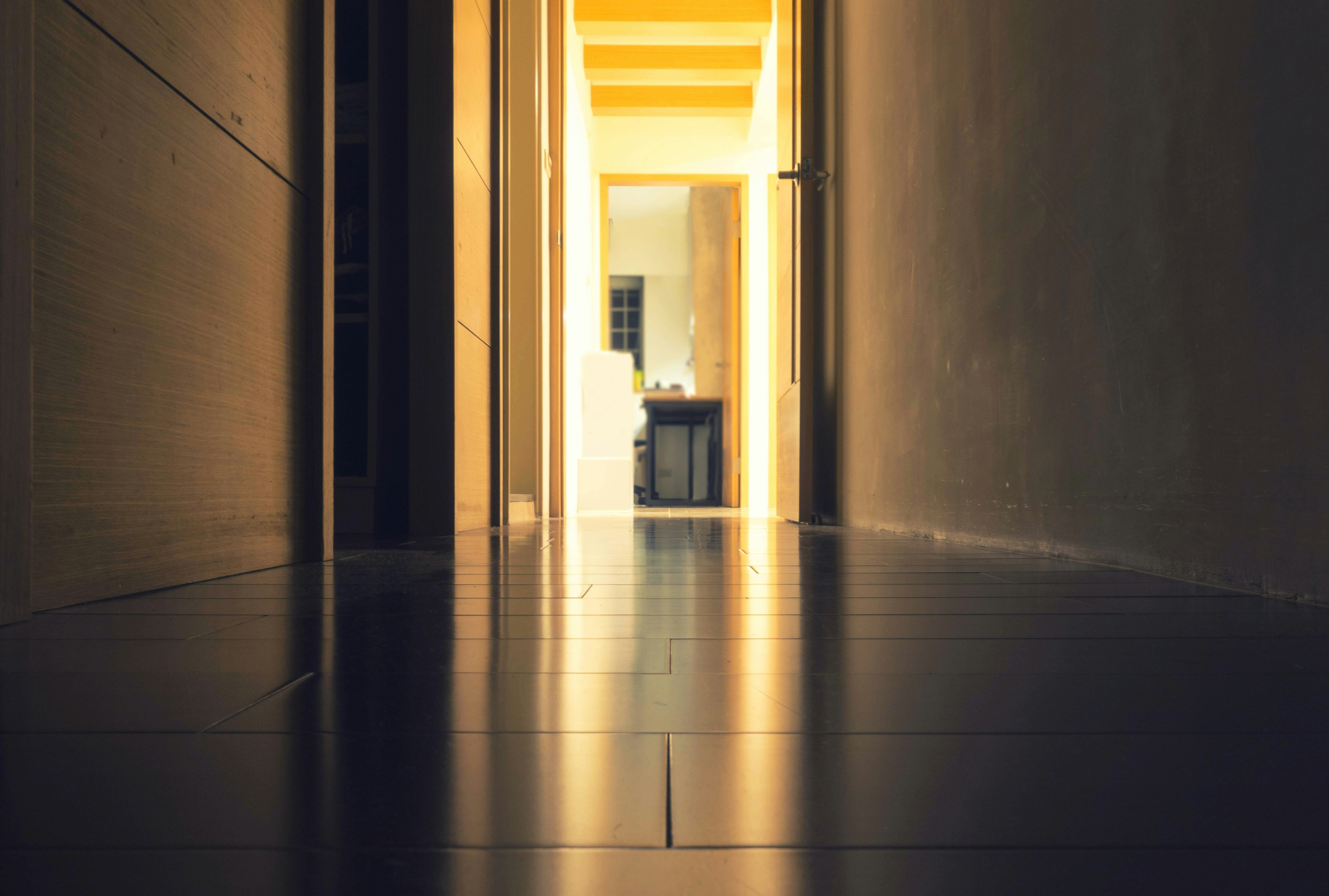
The hallway was the worst. It stretched longer than it should have, and I would stand in my doorway and feel it pulling my gaze all the way to the end. Its carpet was ugly, a dull sandy brown that scratched and left burns on my knees whenever I fell. The texture was rough, mean, and it stayed pressed into my skin long after I stood up. Worst of all, that hallway was where the gorilla lived.